


You’ve just finished a 12-hour flight, and the excitement of arriving at your destination is quickly replaced by dread.
The carousel spins… but you can’t find your bags. You wait impatiently, praying the luggage appears in one piece. But it doesn’t. What now?
Panic starts setting in: Who should I notify? Will they find and return my bags before the trip is over? Can I buy new items if I need them and if yes, who pays? What if they can’t locate the luggage at all? And finally, what was in that bag? Probably the clothes for every occasion, your electronics, cosmetics, shoes, even your sports gear, all gone. You vaguely remember packing some of them… but how can you prove it?
Most travelers don’t realize that without a detailed record of what was in your luggage, claiming compensation can be nearly impossible at the right value. Even items you think are “low value” can add up to thousands of dollars. Suddenly, what seemed like a minor inconvenience turns into a potential financial nightmare.
In this guide, we’ll explore how often luggage really goes missing, why connecting flights are risky, and — most importantly — how you can prepare in advance so that if your bag disappears, you’re not left guessing. With the right steps, you can maximize your lost luggage compensation and protect your belongings from unexpected loss.
Millions of travelers fly every day, and while most luggage arrives safely, mishandled bags are more common than you might think. According to the SITA Baggage IT Insights report, over 33 million bags were mishandled worldwide in 2024, including delayed, damaged, or lost luggage.
Even if your luggage is just delayed, having documentation of what was inside the bags makes it much easier to claim lost luggage compensation for essentials purchased during the delay, and it’s critical if the bag is eventually declared lost.
When your luggage is lost, airlines don’t simply reimburse the full value of your suitcase. Payouts depend on regulations and international treaties, and a detailed record of your items is essential to maximize compensation.
For domestic U.S. flights, the U.S. Department of Transportation (DOT) allows airlines to limit liability for lost, damaged, or delayed bags. The maximum liability per passenger is $4,700. Airlines may pay more than this amount, but they aren’t required to do so.
But without documentation, even this limit may not be fully applied if the airline cannot verify the contents of the luggage.
For most international flights, the Montreal Convention governs baggage compensation. This unfortunately means lower compensations on international flights compared to domestic flights. Maximum baggage liability is calculated in “Special Drawing Rights (SDR)”, but the liability is roughly $2,175 per passenger.
This is the maximum airlines must pay for lost, damaged, or delayed baggage.
If the total replacement cost of your luggage exceeds that amount, the airline is not obligated to reimburse the difference.
Reaching the maximum liability limit reimbursement requires documentation.
Airlines typically require a detailed, itemized list of all the items inside the lost bag, including brands, replacement costs and sometimes even proof (e.g. receipts, photos or videos).
If you cannot clearly demonstrate what was inside your suitcase, compensation may be reduced, even if you’d be technically entitled to the full liability limit.
Airlines assess claims based on declared contents and reasonable valuation, not assumptions.
If your bag contains items exceeding the airline’s liability, the airline will only reimburse up to cap. This means that the remaining amount may only be recoverable through travel insurance, which also requires itemized documentation and proof. Without documentation, the excess value isn’t typically covered for.
Most travelers dramatically underestimate the value of their luggage.
Not the current value, but the replacement cost today. There’s a big difference.
Replacement cost means “how much would you have to spend right now to buy the same items again?”
And when you calculate that number honestly, it adds up fast. And unfortunately that’s the value you should be considering when claiming for reimbursements, because you usually only pack items that you actually need during your trip – meaning you would need to repurchase at least a majority of them if your luggage was lost.
I travelled to San Francisco for 4 weeks, needing clothes for different occasions and weather. If I had to guess, I would have estimated the value of my bags contents to be around $2000-$3000.
But I knew that the risk of losing a bag during my tight connecting flights was higher than average, so I decided to document everything – just in case. After listing every item and calculating the replacement costs, total was over $11,000. WHAT?! That’s insane. And I don’t even wear luxury clothes. Just regular average brands with good quality materials.

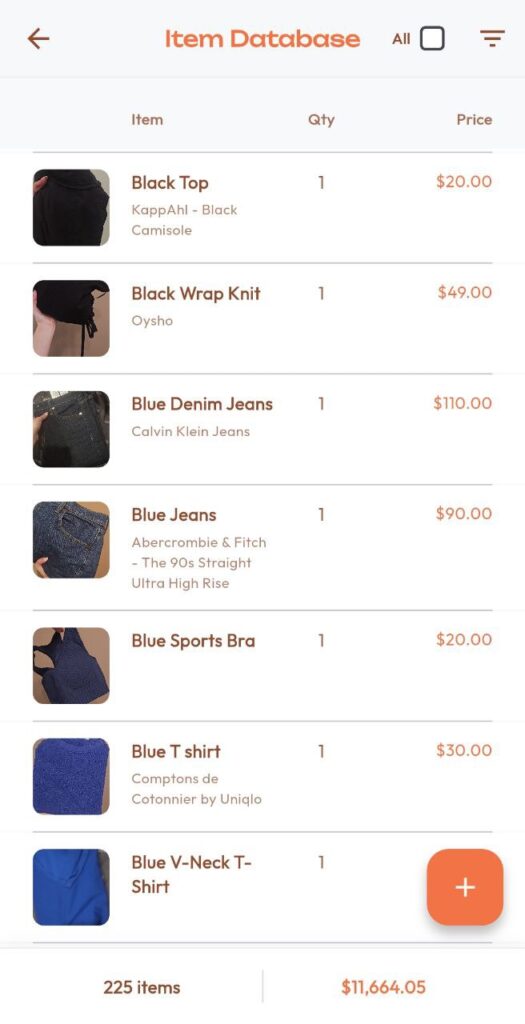
If you start breaking the luggage into smaller portions, you can easily see why the value climbs quickly:
A longer trip typically requires:
Individually, most of these items didn’t feel expensive. Together, they created a five-figure replacement cost.
You don’t need designer brands for your luggage to exceed airline liability limits. Consider a typical 1-2 week trip:
Even modestly priced items can quickly exceed the liability limits. And that’s before considering immediate replacement purchases abroad which are often more expensive, when you don’t have time to wait for sales or longer shipping times from cheaper resellers.
Most of us don’t mentally total up all the items we are packing. It’s easier to think in categories “Some clothes, a pouch of toiletries, the basic electronics”. But airlines and insurers think in line items, and those reveal the real number.
If your bag is worth more than the liability limit, you will have to rely on your travel insurance to cover the difference.
But like I mentioned earlier, even the insurers require an itemized list with replacement costs and proof that you actually owned and packed the items. If you don’t know what your suitcase was worth, you cannot claim your lost luggage compensation to the actual value of the items inside. Whether that’s from your airline or insurance.
Here’s what usually happens:
The bag doesn’t arrive.
You report it.
The airline hands you a form and asks: “Please provide a detailed list of the contents of your luggage, including estimated value.”
And suddenly you’re expected to remember everything, after a long flight, probably in a foreign country, under stress, trying to figure out “what do I wear tomorrow and where can I get a toothbrush”.
Even if you packed carefully, you likely won’t remember every single clothing item or their brands or the exact names of your cosmetics. And how could you know how much the items cost without hours of searching on the web.
Cognitive studies consistently show that stress reduces recall accuracy. Now combine that with jet lag, time pressure, immediate need to buy essentials and uncertainty about whether the bag will be found. You’re trying to reconstruct a detailed financial inventory from memory while worrying about your trip. That’s when undervaluation happens.
What you forget, you can’t claim. When filing for lost luggage compensation, missing items don’t get reimbursed later because you “remembered them afterward.” Claims are assessed based on the inventory you submit.
You cannot build a strong reimbursement claim after the loss, because you can’t trust your memory. That’s why documentation must happen before you travel.
Because once the bag is gone:
If you had documented everything prior to your departure, you’d now have a detailed list to provide the airline or insurer. Without it, your claim is incomplete and will result in a lower compensation.
As documentation is the key to maximizing lost luggage compensation, the next question is simple: How do you document everything without spending hours creating spreadsheets? Here’s an unexpected solution!
We originally created ReEmber to help homeowners document their belongings in case their homes were damaged or destroyed in natural disasters. The goal was simple: make inventory documentation fast and removing the manual cataloging.
But during my own San Francisco trip, I decided to test something. What if I used ReEmber to document what was inside my luggage?
It turns out, it worked surprisingly well. In fact, it was so simple that I wanted to share the method here.
Now, because ReEmber wasn’t originally designed specifically for travel, some of the terminology inside the app might feel a little unusual in this context. But think of your suitcases as your mini home for the duration of your trip. For those days or weeks, everything you own, or at least everything you rely on, lives inside that bag.
Inside ReEmber:
The top level is called a “Property” (normally meaning a home or building).
The second level is called a “Room” (a specific space within that property).
For travel, you simply reframe it:
Property = Your Trip (e.g., “Paris 2026”)
Room = Each Bag (checked luggage, carry-on, personal item)
That’s it. Now you can use ReEmber’s fast technology to your advantage while packing: Before you pack everything into the bag, pile them next to the bag for a moment. Then just film a quick video showing all the items. ReEmber detects all the items, lists them for you and retrieves replacement costs. Then just nicely add the items into the bag and close it up. With just a few minutes of video you just documented everything.
That’s it. No manual typing. No spreadsheets. No wasting hours.
If your luggage is delayed or declared lost:
Instead of guessing under pressure, you submit evidence. And evidence strengthens your lost luggage compensation claim whether with the airline or travel insurance.
Even with perfect documentation, losing a bag is stressful. Here’s a clear step-by-step guide to maximize your lost luggage compensation. Please check your airline’s instructions for more detailed instructions, since these can vary slightly by airline and country.
To claim compensation, you must:
Having a pre-trip documented inventory, like one created with ReEmber, dramatically improves your claim success.
Domestic U.S. flights: Airlines can limit liability to $4,700 per passenger.
International flights (Montreal Convention): Maximum liability is ~$2,175 per passanger.
Airlines may pay more voluntarily, but they are not required to. Your frequent flyer status can affect this, since some airlines are more willing to compensate customers with a high membership status to keep them happy. If you have no frequent flyer status, prepare for not getting anything above the cap.
Travel insurance can cover the amount above these limits, but proof of contents is essential.
Yes, but it’s difficult. Without a detailed inventory, airlines or insurers may:
And if it’s not the airline or insurer capping the compensation, it’s most likely your own memory forgetting half of what you had packed. Documenting your luggage before you travel ensures a stronger, faster claim.
Most airlines try to locate baggage for 21 days before declaring it permanently lost, but they can declare it lost even before that. Once declared lost, you can formally submit your lost luggage compensation claim. Until that you can only submit a “delayed luggage” form to the airline.
Yes, most travel insurance policies cover items beyond airline limits, but:
Using ReEmber to create a pre-trip inventory protects your full luggage value and streamlines insurance claims.
Documenting your luggage doesn’t have to take hours. Here’s a simple method:
The whole process takes 1–2 minutes per bag, giving you a complete, verifiable inventory that strengthens airline and insurance claims.